What are subliminal affirmations, and how do they work?

Subliminal affirmations are spoken affirmations placed beneath music, so quietly that you no longer consciously make out the words. Here's what that means, what research can and can't tell us, and how to try it in a way that suits you.
What "subliminal" means
"Subliminal" comes from Latin: sub (below) and limen (threshold). A subliminal message sits below the threshold of conscious perception. In an affirmation track, that usually means the voice is mixed so far beneath the music that you hear the music, maybe a faint murmur, but not the words themselves.
How a subliminal affirmation track is made
The recipe is straightforward:
- Affirmations are recorded, ideally short, positive and in the present tense.
- They are looped so they repeat throughout the whole track.
- The volume is lowered far beneath the music, often with the voice layered or placed left and right.
- Calm music or sound carries the whole, sometimes with an added frequency or binaural beat.
On Lume Alchemy you control each of these steps yourself: your own recording, your own music choice and the exact level of your voice.
What does research say?
It's worth being honest here. Psychology has studied subliminal perception for decades. Lab experiments show that very brief or very quiet stimuli can have small, short-lived effects on things like attention or preference, mostly under specific conditions. Claims that subliminal audio can reprogram your mind or guarantee results are not supported by solid evidence.
So why do people use them? Many simply enjoy the ritual: a calm track, their own intentions, and time set aside to focus on them. The value often lies as much in choosing your affirmations and returning to them daily as in the audio itself. That's how we see it too: a gentle daily practice, not a magic button.
Subliminal, softly blended or audible?
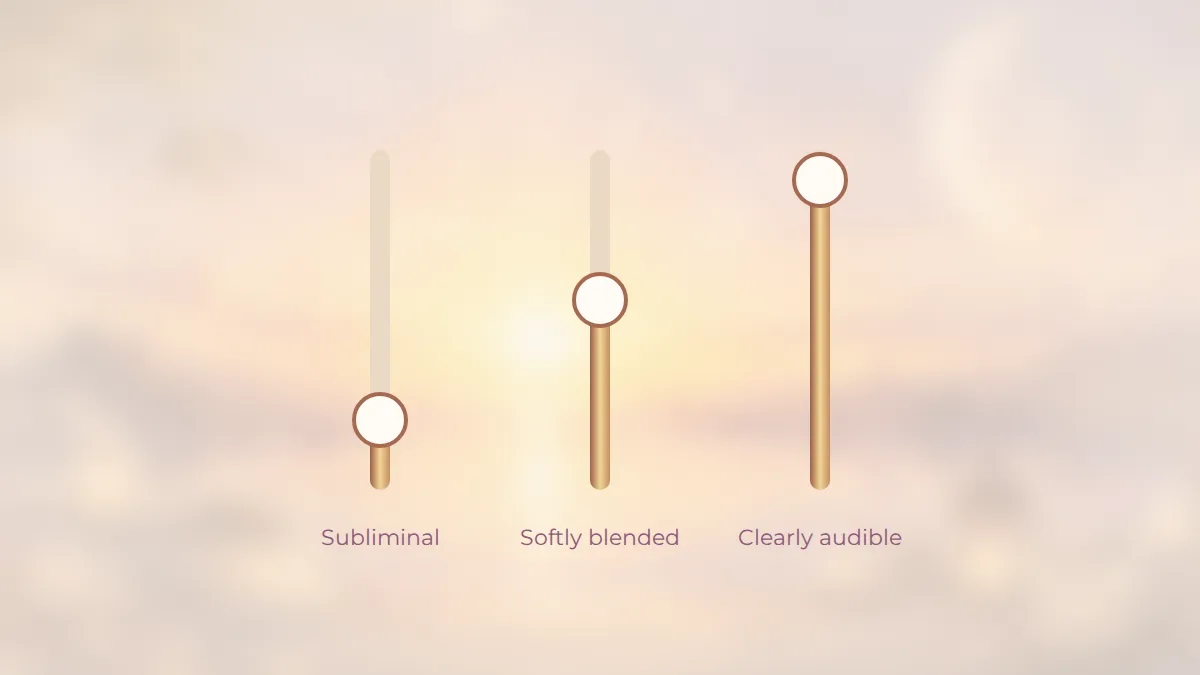
You don't have to choose fully subliminal. Some people prefer to hear every word; others like a soft murmur they can tune into when they want. Each has its own feel, and we explain the differences in subliminal, softly blended or audible: which one suits you?
Tips if you want to try it
- Write affirmations you believe in. Our guide on how to write affirmations that feel true helps.
- Listen to your affirmations audibly first. Knowing what's underneath the music makes the subliminal version feel more meaningful.
- Be consistent. A few weeks of regular listening tells you more than one session.
- Notice how you feel. Calmer? More focused? That personal experience is your best measure.
Common myths
- "Subliminals work instantly." There's no evidence for that. Think of a subliminal track as part of a routine, not a switch.
- "You shouldn't know what's in the track." Knowing your affirmations is actually a good thing: you chose them for a reason.
- "Hidden messages are played backwards." That's backmasking, a different idea from the 1980s. Subliminal affirmations are simply played quietly, not reversed.
- "Louder is stronger." A subliminal track is, by definition, quiet. What matters is that your affirmations are positive, clear and meaningful to you.
Writing affirmations for a subliminal track
Because you won't consciously hear the words while listening, it pays to get them right beforehand. Keep them positive (say what you want, not what you don't), in the present tense, short and specific. Read them out loud once before you record, and change anything that doesn't feel true yet.
Make your own subliminal track
With Lume Alchemy you record your affirmations in your own voice, choose calm music and set your voice from clearly audible to completely subliminal. The 20-second preview lets you hear the result live before you order.
Subliminal tracks are meant for relaxation and personal reflection. They are not a medical or psychological treatment.
Create your own track
Record your affirmations in your own voice and turn them into a 30-minute track with calm music and an optional frequency. Listen to a free preview first.
Create your track